


The production process of PET cold drink cups involves multiple steps, from raw material processing to final shaping. The following is the detailed technological flow (7 steps):
1. Raw material preparation
PET resin particles: Select food-grade PET (polyethylene terephthalate) resin, which must meet hygiene standards (such as FDA certification).
Drying treatment: PET is hygroscopic and needs to be dried at high temperature (about 150°C) for 4 to 6 hours to remove moisture and prevent the formation of bubbles or degradation during molding.
2. Injection molding (prefabricated cup body)
Injection molding machine heating: Heat the dried PET particles to 260-280°C for melting.
Injection mold: Molten PET is injected into cup-shaped molds and formed into preforms under high pressure. The cup blank is in the shape of a test tube, with a relatively thick bottom and a threaded mouth (for subsequent capping).
Cooling and demolding: After rapid cooling and demolding, the cup blank must be inspected for any defects (such as bubbles and deformations).
3. Blow molding (biaxial stretching)
Heating the cup blank: The cup blank is heated to 90-110°C by infrared rays (softened but not melted).
Stretch blow molding
Longitudinal stretching: The mechanical rod stretches the bottom of the cup blank downward.
Horizontal blow molding: High-pressure air (about 40bar) is injected into the cup blank, causing it to expand and adhere to the inner wall of the mold to form the cup body.
Rapid cooling: The mold is shaped with cold water and the finished cup body is released.
4. Cup rim treatment
** trimming** : Remove excess burrs from the rim of the cup.
Thread reinforcement: Some processes will add reinforcing rings at the cup mouth to enhance the sealing performance.
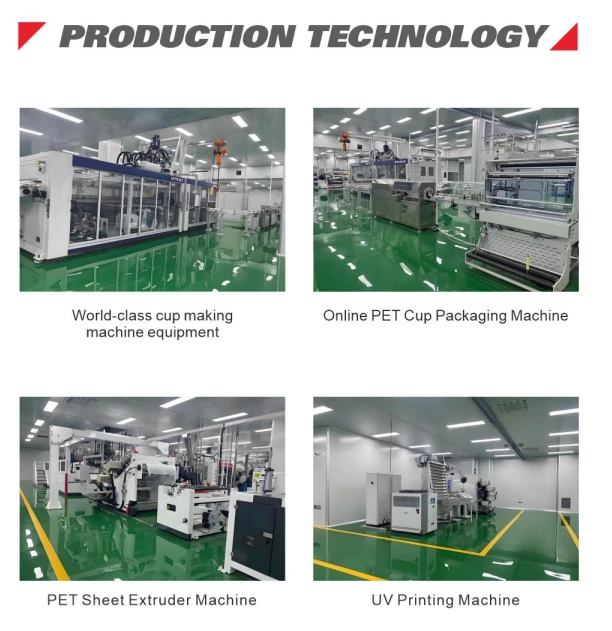

5. Printing and Decoration (Optional)
UV printing: Using eco-friendly ink to print patterns (such as brand logos and designs), and curing under ultraviolet light.
Labeling: Some cups may be affixed with paper or plastic labels.
6. Quality Inspection
Dimensional inspection: Check whether the diameter, height, etc. of the cup mouth meet the standards.
Sealing test: Randomly inspect the fit and sealing performance between the cup and the lid.
Pressure resistance test: Ensure that the cup does not crack easily at low temperatures.
7. Packaging and sterilization
Automated packaging: Cups are stacked and then bagged or boxed.
Ultraviolet/ozone sterilization: Some high-demand products will undergo aseptic treatment.
Key process characteristics
Biaxial stretching technology: Enhances the transparency, strength and barrier properties (preventing CO₂ leakage) of PET cups.
Energy-saving design: Modern production lines may integrate injection molding and blow molding into one, reducing energy consumption.
Application scenarios
PET cold drink cups are widely used in milk tea, carbonated beverages, iced coffee, etc. Their temperature resistance range is usually 0°C to 50°C (exceeding this range may cause deformation).
